Our Location
304 North Cardinal St.
Dorchester Center, MA 02124

304 North Cardinal St.
Dorchester Center, MA 02124
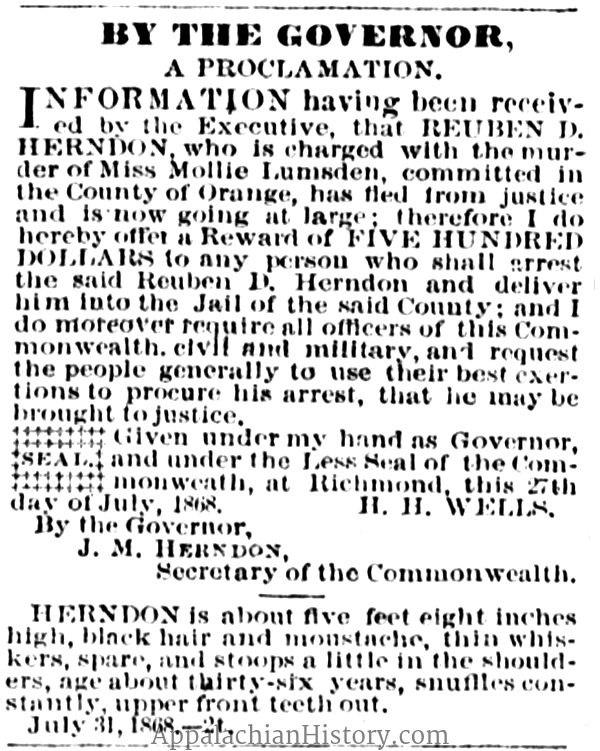
Reuben Herndon became one of the most infamous figures associated with Virginia’s “Ordeal of Blood.” His case, involving a missing young woman, a secret relationship, an incriminating letter, and a gruesome discovery in the woods, offers a dark glimpse into justice in post-Civil War Virginia.
The case began in the spring of 1868 with the disappearance of Mary “Mollie” Lumsden.
Reuben Herndon was a Confederate veteran who lived near Verdiersville in Orange County, Virginia. He had served for the duration of his enlistment before being discharged as a private.
After the war, Herndon married Susan Mason, daughter of Reverend Saunders Mason. He worked as a carpenter and occasionally preached, although he was never ordained.
Those who knew Herndon generally considered him timid and unassuming, seemingly incapable of serious violence.
That made what happened next all the more shocking.
Mary “Mollie” Lumsden was a young woman from a respectable local family and a familiar presence in the Herndon household, where she helped Susan Herndon care for the children.
The Herndons and Lumsdens were neighbors, and both families were well known in the community.
On April 24, 1868, Mollie disappeared.
Weeks passed without any word from her. No one in the surrounding area, or apparently anywhere else in Virginia, reported seeing her.
A month later, the mystery took a horrifying turn.
On the evening of May 24, Mrs. James Jacobs waited for her dog to return home.
When the hound finally appeared, its paws and legs were covered in blood.
Jacobs examined the animal but found no injury that could explain it. There was also far too much blood to have come from a small animal.
Curious and alarmed, she followed the dog’s trail.
Deep in the woods, Jacobs discovered three strange piles of wood.
Beneath them were human remains.
Neighbors were summoned, and when the wood was removed, the victim was identified by her clothing and hair.
It was Mollie Lumsden.
Mollie’s father was among the first to arrive.
A necktie was discovered near the remains. At first, Lumsden couldn’t place it. He eventually remembered seeing Reuben Herndon wearing it.
Mollie’s body had been discovered approximately a mile from Herndon’s home.
Justice of the Peace John Woolfolk conducted an examination and believed Mollie had been pregnant. The condition of the remains also gave rise to reports that the unborn child had been cut from her body.
Then investigators found something even more damaging.
A letter was discovered in Mollie’s pocket.
It directed her to secretly leave the Herndon home and hide in an isolated area until Herndon could meet her. He instructed her not to tell his wife Susan and warned her to conceal her tracks.
Among the instructions, Herndon wrote:
“When you get over to the woods, go down the path a little ways, and then turn to the left … and hide yourself, so if anybody should come along, that they can’t see you.”
He told Mollie that after meeting her, they would flee together and “by morning, we will be out of the reach of anybody around here.”
The letter appeared to lead Mollie directly toward the area where her remains were eventually discovered.
Mollie’s father confronted Herndon and repeatedly asked him to view his daughter’s body.
Herndon refused.
Only after authorities intervened did he finally go to the scene. This incident likely contributed to later stories connecting Herndon’s case with the “ordeal of blood,” although there is no evidence in this account that he was actually forced to touch Mollie’s remains.
When Herndon’s letter was read aloud, he broke down.
Mollie’s furious father accused him of murder and raised a hickory branch to strike him, but magistrate Richard Richards intervened.
Herndon admitted that he had seduced Mollie.
He denied killing her.
Another detail in Herndon’s letter attracted attention.
He had told Mollie that he intended to sell a pair of oxen to a man named Johnson so they would have money to flee.
Johnson had previously tried several times to buy Herndon’s steers, but Herndon had always refused.
This time was different.
Claiming he would be “ruined” unless Johnson purchased them, Herndon sold the animals, valued at approximately $40, for only $28.
The hurried sale appeared consistent with his letter describing plans to leave the area.
Despite mounting suspicion, weeks passed without formal action.
Herndon responded boldly, publishing a warning in The Native Virginian threatening to sue those accusing him of the crime.
Herndon’s proclamations of innocence failed to quiet suspicion.
He was arrested around the beginning of June.
Public anger was intense. More than 100 people reportedly pledged to participate in a lynching at the Orange County jail, although only about a dozen actually appeared. They eventually dispersed without violence.
Herndon hired prominent attorneys Judge Robertson and Shelton F. Leake, who repeatedly succeeded in delaying his trial.
Herndon’s patience eventually ran out.
On July 26, he escaped from jail.
The following day, Virginia’s governor issued a proclamation offering a $500 reward for his capture.
For several weeks, Herndon remained missing.
Many assumed he had fled west or perhaps escaped to Mexico.
In reality, he hadn’t gone far.
Herndon spent weeks wandering the surrounding countryside with little food and inadequate clothing. On August 17, desperate and exhausted, he sought shelter in a barn he mistakenly believed belonged to a relative named Grady.
Instead, the barn belonged to Grady’s neighbor.
Justice Woolfolk was summoned.
When authorities found Herndon, he was pale, emaciated, and exhausted. He claimed to have eaten only five meals in ten days while wandering through rain and rough country.
His bare feet were swollen, bruised, and badly cut.
Herndon’s escape was over.
After his capture, authorities chained Herndon to the floor of his jail cell.
His wife divorced him while he awaited trial, and continuing legal delays meant he did not face a jury until May 1869.
The prosecution eventually constructed an explanation for Mollie’s death that partially incorporated Herndon’s own admissions.
According to the case presented against him, Herndon had seduced Mollie and she became pregnant. Afraid of taking responsibility, he obtained an abortive substance of unknown composition.
The attempt proved fatal to Mollie and her unborn child.
Panicking, Herndon attempted to dispose of her remains. He dismembered the body into three sections but apparently could not complete the task. Instead, the remains were concealed beneath separate piles of wood.
The condition of the body may have contributed to the earlier belief that the unborn child had been deliberately removed.
Herndon was convicted of second-degree murder and sentenced to 18 years in the Virginia state penitentiary.
By late July, newspapers reported that Herndon had become ill shortly after beginning his prison sentence.
He nevertheless continued to insist that he was innocent and expressed hope that the truth would someday emerge.
His final known appearance in the newspapers came in March 1870, when another prisoner stabbed him in the shoulder.
The wound was not serious. Herndon was treated at the prison hospital and returned to confinement.
The newspapers then fell silent.
The case that had horrified Orange County began with a young woman’s unexplained disappearance and a blood-covered dog emerging from the woods. It ended with Reuben Herndon imprisoned for her death, still insisting that he was innocent.

