Our Location
304 North Cardinal St.
Dorchester Center, MA 02124

304 North Cardinal St.
Dorchester Center, MA 02124
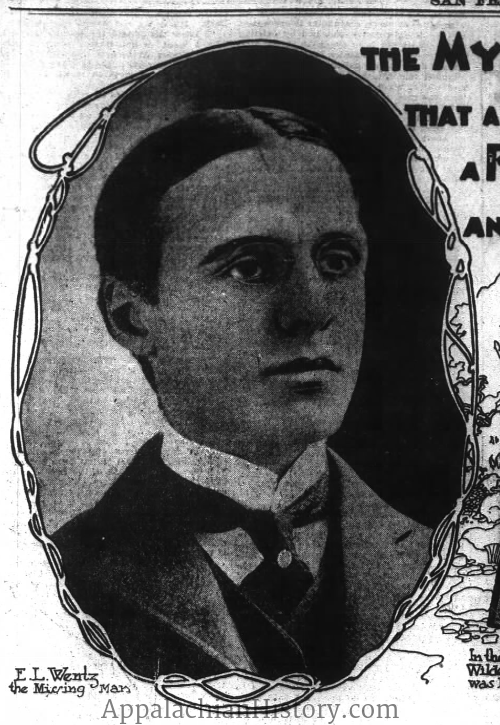
In October 1903, Edward “Ted” Leisenring Wentz, a wealthy young coal executive from one of Philadelphia’s prominent families, rode into the mountains of Southwest Virginia and disappeared.
His disappearance triggered one of the largest searches the region had ever seen. Thousands combed the mountains. Private detectives arrived. An enormous reward was offered. Newspapers across the country followed the mystery.
Nearly seven months later, Wentz’s body was found only about a mile from where his horse had been discovered, in an area that had supposedly been thoroughly searched.
What happened to Edward Wentz remains one of Black Mountain’s enduring mysteries.
The Wentz family had made a fortune in mining and became deeply involved in the coal industry of Southwest Virginia during the late 19th century.
Edward Leisenring, a Pennsylvania native and member of Congress, purchased approximately 150,000 acres in Southwest Virginia shortly after the Civil War. Ownership of some of this property was disputed. Many local residents lacked printed deeds despite their families having occupied the land for generations, while other property had been confiscated from suspected Southern sympathizers.
The Virginia Coal and Iron Company was incorporated in 1882 and eventually controlled vast holdings across Lee, Scott, and Wise counties in Virginia and into Harlan County, Kentucky. Its operations included mines, coke ovens, timber reserves, and coal properties around Blackwood, Big Stone Gap, and Stonega.
For local families, the arrival of the coal companies brought enormous changes.
People who had traditionally hunted, gathered herbs, collected firewood, or grazed animals on mountain land suddenly found themselves accused of trespassing. Some families were labeled squatters on property they believed had belonged to them for generations. Others were charged rent to remain in their homes.
It was into this volatile environment that young Edward Wentz arrived.
Wentz was only 25 in 1903. Independently wealthy through inheritance, he had little financial need to work, yet he chose to settle near Big Stone Gap.
His father, Dr. James Wentz, appointed him general manager of the Virginia Coal and Iron Company, while his older brother Daniel served as president.
Edward soon became far more than a company executive.
He personally patrolled company property, removed alleged trespassers and delivered eviction notices. Contemporary accounts accused him of using a horsewhip to punish those who resisted him. Newspapers described him as determined to bend local residents to his will.
He also served as the company’s land agent and later joined a police guard tasked with maintaining order in the region. Some accounts claimed he also served as a federal marshal.
Whatever his precise authority, Wentz had accumulated considerable power, and plenty of enemies.
Several months before Wentz disappeared, he participated in a July 1903 raid against an illegal distillery believed to have been operated by Thomas Daniels.
The raid turned deadly.
Daniels was shot several times. Rather than taking him to an ordinary physician, Wentz had him transported to the company hospital. Daniels’s relatives were reportedly prevented from seeing him afterward, and he was never seen alive again.
Stonega Police Chief James King, who worked with Wentz on moonshine raids, was also shot and killed during the violence.
The episode produced resentment and suspicion. Later, when Wentz himself disappeared, revenge became one of the most obvious theories.
On October 13, 1903, Wentz played tennis with John Goodlow and reportedly displayed no signs of distress.
The next day, he telephoned his assistant, Samuel Wax, and said he intended to travel upriver to visit Samuel’s brother, Charles Wax. Wentz was also preparing to deliver eviction notices and arrest warrants to alleged trespassers.
He rode away on October 14.
Wentz was last seen near Kellyview, a small stop on the Louisville and Nashville railroad. Several hours later, his horse was discovered wandering near Ramsey Creek Ford.
Wentz was nowhere to be found.
His brother Daniel initially believed Edward had continued to Charles Wax’s home. He hadn’t.
Edward Wentz had simply disappeared.
The disappearance quickly became national news.
Miners were pulled from work to participate in the search, and the Wentz family hired private detectives. Novelist John Fox Jr., a friend of Wentz, traveled from New York to help.
Thousands of people eventually searched the mountains and valleys of Virginia and Kentucky. Bloodhounds were brought in, and the reward for information climbed dramatically, with some reports placing it as high as $100,000.
Still, there was no sign of Wentz.
The publicity inevitably attracted hoaxes. Ransom letters arrived from across the country.
Months after the disappearance, a well-dressed young man entered the Wentz offices in Big Stone Gap claiming to know who had kidnapped Edward. He said the kidnappers wanted $25,000 for his return.
The family requested proof, such as a sample of Edward’s handwriting or one of his personal possessions.
The stranger left without receiving any money. Company representatives followed him, but he disappeared into the mountains.
Eventually, the Wentz family stopped discussing the case with reporters.
On May 9, 1904, miner David Raleigh was searching for a missing cow near Pardee when he stumbled across a partially decomposed body.
The clothing was immediately familiar.
Edward Wentz had been found.
The location created another mystery. His body lay only about a mile from the place where his horse had been discovered the previous October.
More importantly, searchers claimed they had already examined the area.
William Hayes, who had been responsible for searching that section of the mountain, insisted his men had found neither a body nor a weapon. Bloodhounds had also failed to pick up Wentz’s scent.
Some believed dense vegetation had concealed the corpse. Others wondered whether Wentz had died elsewhere and his body had later been placed there.
Wentz had apparently been dead for some time. Portions of his hair and clothing had been burned during a recent forest fire, but his remains were identifiable.
His right hand was missing, generally attributed to animals. Several teeth were also gone.
Most significantly, Wentz had been shot.
A .32-caliber bullet had entered the front of his body, passed through his heart, and lodged near his spine. Powder burns reportedly indicated that the weapon had been fired at extremely close range.
Doctors also found that blood had pooled in Wentz’s back and the backs of his legs, indicating that he had died while lying down.
Yet his body was discovered in an almost seated position against a log.
His Smith & Wesson revolver was found approximately 18 feet away. Three rounds had been fired.
At what, no one knew.
A pearl button was also discovered near the body, but apparently little effort was made to determine where it came from.
The Wentz family attorney, F. Bullitt, believed Edward had struggled with attackers and suspected revenge connected to the Daniels raid. Daniel Wentz reportedly agreed.
Then came perhaps the strangest development of all.
After Wentz’s death, the public learned something even his family apparently had not expected to become part of the story.
Edward had been secretly engaged.
His fiancée was Cornelia Brookmire of St. Louis, a wealthy young woman and friend of Wentz’s sister-in-law. The couple had reportedly been engaged for nearly a year, although the Wentz family opposed the marriage for reasons that were never publicly explained.
Brookmire traveled to Wise County after Edward’s body was found and remained at his home for about a month in mourning.
She later said Wentz had once been romantic and impetuous. Their relationship progressed quickly, and he proposed after a brief courtship. Yet after their formal engagement in the summer of 1903, Wentz reportedly became distant and appeared to lose interest in both her and marriage.
This revelation produced another theory: suicide.
Some speculated that Wentz had killed himself because his family refused to accept Brookmire. According to one version of the story, his father threatened to remove him from his position in Big Stone Gap if he married her.
The theory had obvious problems. Wentz was independently wealthy and did not need his position to support himself.
His activities immediately before disappearing also gave little indication that he planned to take his own life.
There was no shortage of theories.
Perhaps Wentz had been ambushed by people who resented his treatment of local residents. Perhaps relatives or associates of men involved in the Daniels raid wanted revenge. Some believed he had been kidnapped and held somewhere in the mountains before being killed.
Others argued that his body had simply been overlooked during the original search.
There were even claims that Wentz had voluntarily disappeared before meeting his death.
Despite the circumstances, the coroner’s jury returned a startling verdict:
Accidental shooting.
The decision baffled many who had followed the case.
Wentz had suffered a close-range gunshot wound through the heart. His revolver was found 18 feet away with three rounds fired. His body appeared to have been moved from the position in which he died.
Nevertheless, his death was officially considered an accident.
The family’s reaction raised still more questions.
Edward’s brothers traveled to Virginia to escort his remains back to Pennsylvania, but reportedly showed little interest in visiting the location where his body had been discovered.
Although the family publicly objected to the accidental-death verdict, they did not launch a major independent investigation. Their private detectives were dismissed, and the family chartered a train to carry Edward’s remains home.
Dr. James Wentz publicly insisted his son had neither committed suicide nor accidentally killed himself. He reportedly accused local authorities of protecting someone responsible for Edward’s death, although he later withdrew those accusations.
Then the case gradually disappeared from the newspapers.
More than a century later, the basic questions remain.
Why wasn’t Wentz’s body found during the enormous search?
Why did bloodhounds fail to locate him?
Why had three rounds been fired from his revolver?
How could a close-range bullet through the heart be ruled an accidental shooting?
And if Edward Wentz was murdered, who killed him?

